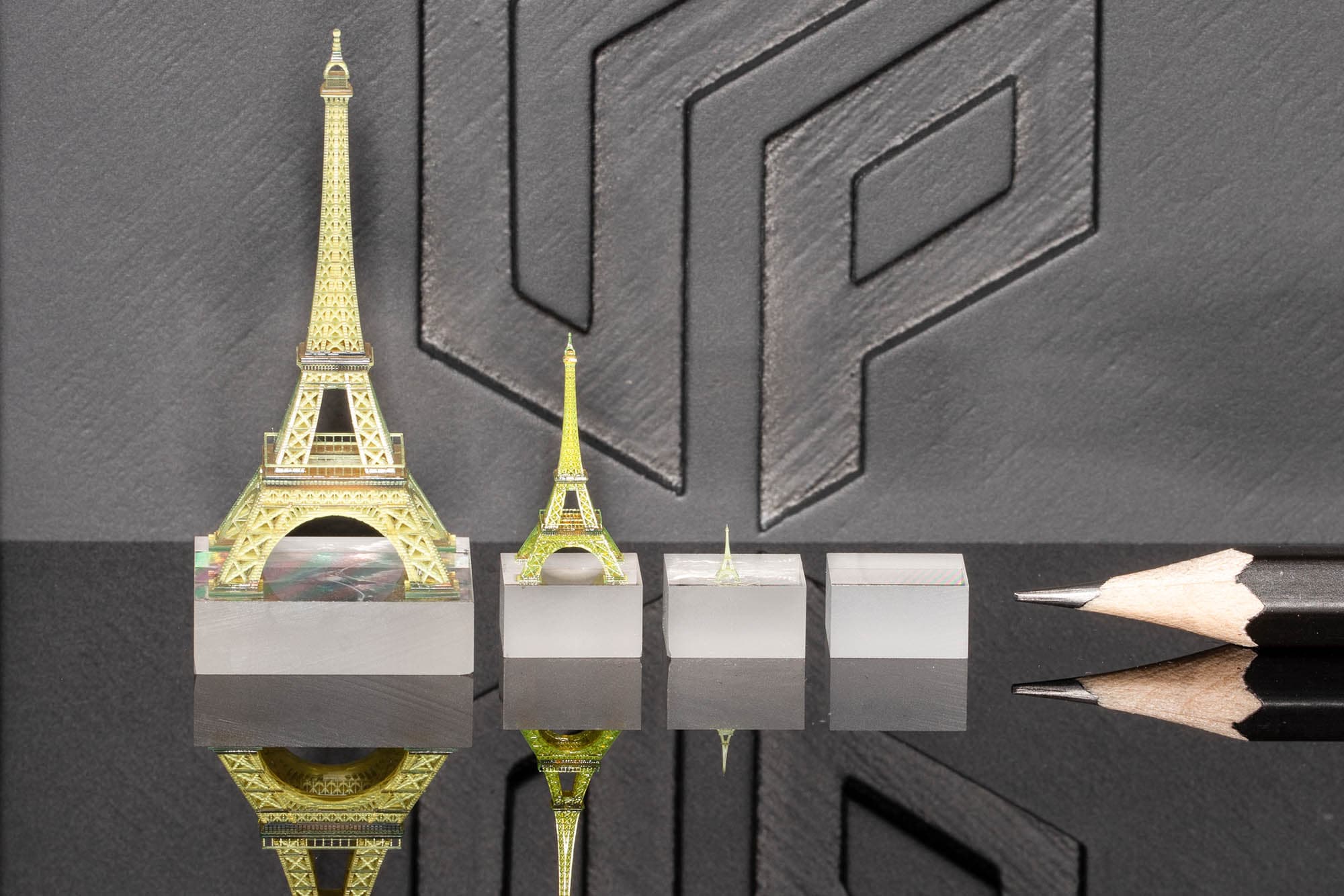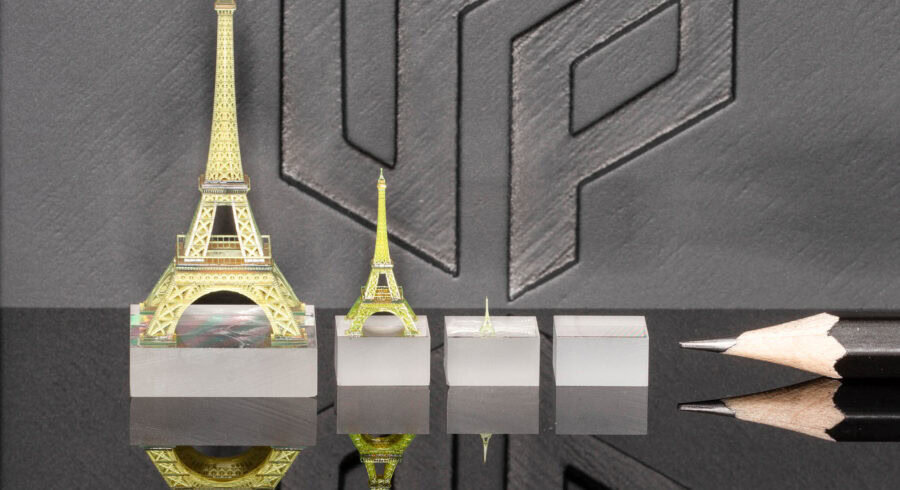
2-photon polymerization (2PP) 3D-printing is an ultra-precise production technology that so far could only be optimized for a very limited range of scale. Also, production in the centimeter-range (meso-range) took extremely long time and thus was unattractive for quantitative production in industry. The Austrian UpNano GmbH now demonstrates what seemed impossible: Their NanoOne printing system can produce highly precise specimens with nano- and micrometer resolution that range from centi-, to milli- to micrometer in size. And this within minutes.
Photons with Power
„We developed and patented an innovative adaptive resolution technology for our 3D printing system”, explains Peter Gruber, head of technology and co-founder of UpNano. „Together with an optimized optical path and smart algorithms, we can utilize the full laser power up to 1 Watt, which is several times more than in comparable systems.” Such a powerful laser delivers enough energy for high-speed printing especially in the adaptive resolution mode. This, in fact, is a significant advantage compared to other systems that use weaker lasers and are therefore limited in throughput.
„The benefit of this innovation”, adds Bernhard Küenburg, CEO of UpNano, „is most notable in the meso-range. The NanoOne system offers significant faster production times than other systems. Add our patented adaptive resolution technology to this and you end up with a capability to print centimeter large objects with a micrometer resolution in short production cycles.” This algorithm allows a widening of the laser spot up to a factor of 10 in accordance with the specifications of the printed specimen. A simple change of objectives (there are different ones available, ranging from 4x magnification to 100x) allows the production of parts in the micro-range with resolutions at the nanometer scale. This, too, is much faster than other systems thanks to the specific optical pathways, the optimized scan algorithms and the proprietary adaptive resolution technology. In fact, the NanoOne is capable of manufacturing objects with volumes ranging across 12 orders of magnitude. Dimensions in the micrometer-range are equally possible as in the centimeter-range, while maintaining ultra-high resolution. And all that in the shortest possible time
From R&D to Industry
Thanks to this high versatility, the system has been met with great interest in R&D and in industry right after its introduction. An example for its use in medicine and research is the production of micro needles with tight tolerances and defined features such as the sharp tip, the cannula or reservoir.
Functional micro-mechanic parts reflect another interesting area of application for the UpNano technology. A benchmarking example is a functional spring with a height of 6 millimeter printed in less than 6 minutes or two-components parts with included moveable elements, printed in single printing jobs for med-tech applications.
Filters are the third of numerous examples demonstrating the size-range of the NanoOne. Sizes of several square centimeters with pore sizes in the low single digit micrometer-range can be printed within hours. “Such filters have exactly defined pore sizes for 100 percent of all pores”, explains Bernhard Küenburg. Variations in pore sizes are thus as much history as are unsatisfying filter results. In this way, the NanoOne of UpNano offers a new horizon for filtering and separation processes – a horizon that exemplifies the innovative power of the company.
Images available upon request or Image available at: https://web.tresorit.com/l/UxslY#XlCppewtpI4KpQ6Mxy6N7g
About UpNano (September 2020)
Founded in September 2018 as a spin out of the TU Wien, UpNano is a Vienna-based high-tech company with the focus on development, manufacturing and commercialization of high-resolution 3D printing systems based on 2-photon polymerization. With the first commercial product, the printing system NanoOne, microparts with structure details ≥170 nm can be printed. Due to the very fast printing process, also meso scale parts up to several centimeters in height can be realized.
Downloads